Thursday, February 2, 2012

"To Study Football"

Even more than I am a fan of soccer, I am a fan of African soccer fans. So, after hearing that my school had a TV, I had asked my students to tell me the next time there was a game in the Africa Cup so I could watch it with them. I thought the games were on Saturday though so I was caught off guard when Faustin was waiting for me on my porch on Friday afternoon when I was coming home from a walk with Beans. Apparently, Tunisia and Niger had started playing 12 minutes ago! It hadn't rained all week, but of course it started at that exact moment so we ran to the school under a couple of umbrellas only to find that there was no reception because of the storm. All the boys were crowded together in the cafeteria with their eyes fixed to a black screen while the one boy with a raincoat stood outside in his rain coat trying to adjust the satellite dish. Finally, the game was on and the teams were tied 1-1. My boys scooted around to make room on a bench for me in the front. The reception went in and out a couple of times and the image was fuzzy, but it was football! On TV! In the middle of nowhere, Rwanda! My students crowded around to explain Kinyarwanda soccer terms to me (of which, I only retained the off-sides rule or “kwiherera” that translates literally to mean “to be alone”). My students predicted Niger would win, but they would have been excited no matter what the result because they ended up cheering for just about everything. Tunisia ended up slaughtering Niger, scoring twice in the last 20 minutes, leaving the final score at 3-1.


It was time to eat. It was already 8:00 so those boys piled out to get their food FAST. I made my way out of the school to make my own dinner and overheard the girls singing in the dormitories, which made me realize that not a single one of them had been in the cafeteria. I guess it's not considered very feminine to take too much of an interest in sports.

The Call to Prayer

I meet Karim at the cowboy shack and wait for him on a small, wooden bench while he washes his arms and legs in a basin outside and retreats quickly to change into his ikanzu (dress) for Mosque. I play with one of the dogs, whose name is Naga and talk to another of the cowboys, while I wait. He asks me what my religion is. Uri Catolica (are you Catholic)? No. I just live by the Church. Uri Musilim (are you Muslim)? No. I just want to know Islam. Karim is ready to go. He is wearing a white dress so clean and bright that I am amazed that he has managed to keep it that clean in the cowboy shack, a white hat, and a red and white scarf that he changes intermittently to cover his head or his shoulders. As we pass the school, a few of the students shout “Assalamu Aleikum” and I can't tell whether or not they are being serious. It dawns on me then that the reason the Muslim community here is so welcoming to me is might be because they, too, understand what it feels like to be treated differently. Past the school, the village is almost silent. I guess noon isn't a busy time of day because most people go home to eat lunch. But not if they need to pray, and that is exactly what we are headed to do. Karim asks me if there are Muslims in America and if I know any. There are and I do. I tell him that I used to live directly next door to the Mosque when I went to university and it strikes us both as odd that I never thought to venture inside. The Mosque is a small, but beautiful white building with green trim standing on the top of a hill behind the marketplace. By the time we get there, I am already sweating a bit from wearing a a long dark skirt, long-sleeved back shirt, and wrapping my hair up in a scarf. Karim introduces me to a few of the men out in the front. They don't seem to know what to do with me, but the man in charge figures Karim should take me around to the other side of the building. I don't think Karim has ever been back there, but he takes me around to a door in the back and hands me off to one of the women. I take off my shoes and enter to sit on a mat behind a large, gold curtain that divides the women from the men. There are only four of us in the room. I am happy to see Mama Fatuma, whose husband, Ruru, is one of my favorite vendors. I sit down and the woman next to me covers my feet and hers with an extra piece of igitenge cloth she is wearing. The prayer begins, although none of us can see the man singing it. We just sit quietly and my legs start to cramp. A few more women trickle in, along with their children. A girl around my own age sits down to my right, where there is a gap in the curtain and spends the rest of the service mischievously peeping into the other room. I find out later that her name is Haciza, which means tomorrow or future. With the children there, it feels more like an over-staffed day care than a place of worship. The women pass off their babies, silently break up a couple of minor scuffles, and crinkle their eyes when their children sit, handing each other pieces of bisqui (cookies) and giving each other baby kisses. At only one point do we need to get up and pray, transitioning between standing, bending halfway with our hands in our laps, kneeling, and placing our foreheads on the ground. I have to focus a bit on getting the routine down correctly. After the prayer has finished, they lift the curtain. They are having an election and everyone needs to participate, including me. I'm not sure what positions people are vying for, but I can understand some of what they are saying. Ruru stands up and explains that he is a hard-working shop-keeper and that he has a wife and a child, signs of prestige in Rwandan culture. Everyone raises his hand for him when he is finished. Several others speak, most with unanimous votes. I'm struck by the smallness of the Mosque compared to the humungous Mass on Sundays. This feels more like a family gathering. Everyone knows each other; everyone has a turn to speak; and everyone is supported in doing so. When the elections are over, their attention turns to me. They are asking about the visitor. Karim tells everyone what he knows about me. He says that I am not a Muslim, but that I know Muslims in America. He tells them that I am a volunteer and I will be here for two years. Only. He also makes a point of telling them that I have a boyfriend, a welcome part of any introduction. After Karim has finished introducing me, an umugabo munini (fat husband, which I've come to understand almost always means a man of power) approaches me and asks if I want to convert to Islam. Right this second. I politely tell him that I cannot be Catholic or Muslim because I believe that all religions are good. He seems to be appeased by this response, but still wants to bring me books on Islam in English, which I thank him for. It's not the first time I've been offered religious material in this country and I am interested in reading it. After our conversation, they put the curtain down again and end the service with another prayer. Haciza and I are the first of the women to stand so we can stretch our legs outside , but before long, Karim finds me and takes me by the arm to walk me home. He is somewhat protective of me and I wonder if he even thinks I could find my way back home on my own (which I could, no worries) or if he is simply fulfilling his role as a host.


Now, when I walk to the market, there are so many more people that are happy to see me. Granted, this has forced me to learn yet another set of new greetings, but the effort has been entirely worth it. I also realized that one of my students was attending the Mosque service, which made me realize that students aren't excluded from having a high quality (or Catholic) education just because of their faith, something I am happy to know.

Wednesday, January 25, 2012

A Brief Tribute to Cowboys

Cowboys are awesome. This is why.

Having lived in Colorado for most of my life, I would have thought that I had a pretty firm handle on what it means to be a cowboy. However, what it means to be a cowboy in Colorado and what it means to be a cowboy in Rwanda are almost entirely different things, the only similarity being that they both have cows. For one thing, Rwandan cowboys do not have horses. For another, they do not have land. Your average Rwandan cowboy is therefore a man (or little boy) with a stick, chasing their cows around on foot all day. Fortunately for them, there are so many of them that they have practically become institutionalized outlaws since there isn't the funding to actually crack down on the rather non-threatening act of illegal grazing.

I don't know if it's because of their lawlessness or because of their poverty or what, but the cowboys are some of the most generous people in my community. Despite living three men to a shack with no door, they're less interested in asking me for things than they are in sharing, whether it's that they offer to take me to Mosque when I ask or they offer me a seat and some milk (which is fresh from the cow and unpasteurized so I can't actually take it, but it's the thought that counts) when I stop by to visit, they always go out of their way to make me feel welcome. The one time they did ask me for anything was when they tried to sell me a puppy, but now that I know them better, I think this was less because they wanted the money and more because they thought it would make me happy. I think they would have actually been quite sad to give it up.

They have three other dogs of their own, all of which are well fed, trained, and cared for, which means they know better than to be afraid of Beans whereas the majority of people make a point of informing me they are worried she will eat me in my sleep when they see me walking her. Instead they rough-house with her a little bit and let her have some of the milk they're putting out for their own dogs. It's nice to have a place to go where I play with my dog and not feel like I'm scaring the locals and even better to have some friends that are animal people like me.

Questions, Questions, and More Questions

Three weeks ago, I started to do what I actually came here to do: teach. That's three weeks that I have been running around with my head cut off, trying to make sense of a world that is simultaneously frustrating, uplifting, thought-provoking, and hilarious. I don't know if I can fit the entire spectrum of what I have been faced with into one blog without doing a disservice to some of it, but I am fairly certain that, the longer I put it off, the harder to will be to do so here it is.

The start of term in Rwandan schools in notoriously chaotic. Students (and sometimes teachers) show up a week or two late to school, the schedule isn't decided until a month in, and even then, no one sticks to it. I think things are a bit different at mine. Besides a steady trickle of additional students coming into the classroom, things went off without a hitch for me. I spent the first day on introductions. I thought this would be relatively simple. And I was wrong. In America, students don't normally want to know a whole lot more about their teacher besides their name and whether or not they assign a lot of homework. In Rwanda, it is a custom for students to spend the first day of each term asking their teachers questions about themselves, a custom I hadn't taken all that seriously because I didn't really think that there were even that many questions to ask. But there are. So, for three straight hours on my first day of school, I got to answer awkward questions about myself, questions about where I'm from (explaining snow was fun), questions about my family, my studies, my university, the American education system, and, most importantly, the big one, “Are you single?”

Soon enough, I was able to turn the heat back onto my students and made them tell me about themselves, giving me only a fraction of the information that had pulled out of me, but valuable information nonetheless. Knowing the names of your students isn't a requirement for Rwandan teachers, but it is a requirement for me so I made each of my students a name tag to help me learn them. This was a completely foreign concept. When I brought the name tags to class (having already explained them the day before), their unanimous question was “Teacher, what is the significance of this paper?” The significance?... the significance is that it's your name and that I'm planning on using it when I talk to you because you should feel significant in your own classroom. I also like learning their names. Some of them are difficult and in Kinyarwanda (Enock, Nadjilla, Bahati), some of them are quaint and easy to say (Jean Peter, Pat, Innocent), and some of them are straight up ridiculous because I told them that I would call them whatever they wanted to be called in my class (Priestartist, 44 shooter, Holy Mafia). There is apparently a lot to be learned from somebody's name alone.

I also made them tell me their age, which most of them thought was unfair because I had made the decision on day one not to disclose my name for fear that I would lose the respect of my students if they knew how young I am, telling them I would tell them when they graduated. This was definitely a good call. I slip and call them kids sometimes in a sad, subconscious effort to make myself feel like more of an authority figure, but half of my students are older than I am, ranging from 16 to 25 years old. Conversations held over the lunch break and after school have informed me that most of them are as old as they are because of opportunities lost in the year of 1994. Many of them now are the “chiefs of their households,” meaning that there are no parents left to take care of their younger siblings so it is on them now. They are burdened with heavy questions, questions they pose like this:

“Catie, in your opinion.......

How may I stop my mind from worrying about my family when I sit down to study?

Can someone be successful in Africa without the opportunity to go to university and no capital or connections?

And.....

Why do the leaders of this world do nothing while other people are dying?”

Answers like meditation and self-initiated job creation can begin to satisfy the need for an answer to the first two, but the latter has me caught up in an existential crisis that I can guarantee will last me longer than the two years of my service. I ended up writing my friend Moses in Uganda and asking him to start up something like an advice column for some of my students because I knew I wasn't the right person to be fielding their questions. Even when they aren't asking questions, my students can be overwhelming. I have found myself in shock this evening when one of my students casually mentioned that he was afraid to swim because his father was murdered on a boat during the genocide and then asked me what ice cream is.

In an attempt to indirectly address some of the issues my students seem to be concerned with, I gave them a lesson on Martin Luther King, which has rapidly expanded into a whole unit on human rights, nonviolent vs. violent revolution, and what it take to make change in the world. One of my classes is so invested in the topic that they actually chose to have a history lesson today instead of playing a game so I'm planning on introducing them to Malcolm X next week and having a mock debate from their two perspectives.

English Club is one of few retreats I can find to have lighter topics of discussion. It's three times a week and run by none other than my fabulous dog sitter Priestartist/Faustin, who, I am convinced, will someday rule much more than English club (seeing as he does aspire to be a Music Superstar/Doctor and spends his free time attending national conferences as a representative of the youth of our district). In the meantime though, he organizes topics of dialogue and persuades even his older peers to humor him in a games like Simon Says over their lunch breaks. English Club is completely optional so its members are confident and enthusiastic, which makes it fun for me to be there and a great place for me to test out new game ideas for my classes.

The teachers also have their own Teacher English Club, which is pretty much the polar opposite of the student English Club. Student English Club is run by students, but Teacher English Club is (apparently) run by me. Student English Club is willing to play games, but Teacher English Club is too serious. Student English Club lets me act any way I like, but Teacher English Club insists that I compose myself in the manner of a Rwandan teacher, which is “to be very serious,” never to use the eraser myself and always exit the class before any of my “students” can leave. Of course, the biggest difference is that my teacher students are actual horrific classroom participants due to the fact that most of them are too shy to actually speak English, seeing as they spent most of their education learning French and only recently have been forced to make the switch to English. They're terrified of actually using English and absorbed in the details of the difference of the simple present and present perfect tense and when it is appropriate to use the word “for.” That's not to say that they can't speak English though. They can and they do when they are one-on-one, but getting them to do it in our mock classroom is a battle.

Despite its challenges, I have to admit that I have a pretty cushy setup as far as my school goes. Burdened as my students are, they are privileged to three meals a day (that's three meals a day more than most schools in Rwanda can guarantee their students), running water, and electricity to study by at night. Discussing the hard stuff pays off because I know that they actually have a chance to take what they are thinking about and apply it when, someday, they are actually leading their country. It's hard to know what they've been through, but it is inspiring to think about where they are going.

Friday, January 13, 2012

Getting My Hands Dirty

I had never lived alone until the past month of my life and I had certainly never lived alone in a foreign and developing country so I was terrified at the prospect of starting my life at site. Probably shockingly to anyone who knows me and knows how much of an extrovert I am, I am ecstatic to have the house to myself. It means that I can do all of the weird American things I want on a daily basis. I can do workout videos in my living room, I can listen to music, and, most importantly, I can eat....things that I can taste. My first ventures into the world of cooking in Rwanda have been more than satisfactory. I stocked up on pasta and learned to make a mean marinara and Thai peanut sauce almost from scratch. I even made my first few batches of french-fries! On top of all my, less-than-healthy comfort food, I've finally been able to make myself a fresh salad with homemade vinaigrette, which has become a staple with almost every meal to make up for not being able to eat a single fresh vegetable during my three months of training. Last weekend, I even learned how to make yogurt, which means that I can have either strawberry or honey-cinnamon (or honey-cinnamon-peanut butter) in the morning instead of my normal eggs with veggies. And tonight, it's time for cheese sauce. I know that to my readers at home, my culinary adventures are probably somewhat less stimulating than my cultural ones, and we'll get to those, but I feel that, to truly convey my experience here I have to be honest about the things that take a priority in my life and quality cuisine is definitely one of them.


But I'll get on to the good stuff since I've done much more than sit around locked up in my house cooking. I do, after all, have to go to the market to buy ingredients and I spend a great deal of each day on foot, greeting people. Rwandans love greetings and nothing seems to make my village people happier than seeing me walk (or run, depending on the time of day) down the street saying “Mwaramutse!” (Good Morning) or “Mwiriwe!” (Good Afternoon) to everyone I see. As another a way to get integrated in my community, I've taken up farming. The nuns down the street from me help to run a farming cooperative, which has turned out to be a great place to make friends in the community. On the first day that I picked up a hoe, is was a huge shock. My friend Marigo was beyond incredulous that I was actually capable of doing the work. She kept on asking, “Azi gukora?!?” (she knows how to work?!?) and I don't think she believed it until she saw me with her own eyes. So farming has gone a long way towards changing my community's initial perceptions of me as an American, as well as providing me with something I like doing to fill what would probably otherwise be painfully dull days. One of my happiest days here was spent just sitting in the dirt, cutting the roots and shoots off of onions with a couple of breastfeeding mothers. I had already cut on one of my fingers (ironically, from chopping an onion the night before) and the juice was making it sting and we were there for so long that I got a sunburn and a callouses on my hands, but the sense of togetherness that comes from making sure that everyone has food on the table when they go home is insurmountable.


Sadly, the same mindset that seems to make people so ecstatic to see me farm has had some negative repercussions in my community. People seem to think that white people don't know how to work, not because they are incompetent, but rather because they never have to do it at home. I am definitely humbling myself by being willing to get my hands dirty. I found that some of the villagers are under the impression that there is a hierarchy of race in which white people don't need to work because they are, by far, the best. I had a particularly heartbreaking conversation with a young man who was convinced of the fact that white people were the best “class of race” and that they were followed by brown and then by black people, who were lowest and least promising of the races because God had created them last (He then asked me for books on the apocalypse). This is, of course, precisely the opposite of any scientifically-based telling of the origins of humans. It might just be me, but I find it ironic that the same people that are convinced of my inherent superiority are also shocked that I can somehow manage to lift a hoe and simultaneously infuriating that someone found it acceptable to brainwash the people of Rwanda into a framework that makes them feel inferior.

Whether I like them or not, these are the perceptions I'm up against and I'm working hard to change them. It's not enough that to that I told that boy about the discovery of the world's oldest human bones in Ethiopia or the multitude of accounts of a brown or black historical Jesus. Everyday, no matter how much of a hurry I'm in, I have to take the time to stop people on the streets that call me Muzungu and tell them my name, explaining that I don't like the word Muzungu because it means the same things as different, but I'm a person, just like everybody else. I only wish I had the Kinyarwanda skills to explain that skin color is determined by one, singular gene in the entirety of a person's DNA. Normally my explanations go a long way, but there are definitely days that I have my setbacks. For instance, days on which missionaries have come to visit the church. Now don't get me wrong, I have friends who are missionaries and I truly believe that their work can be good and the church visibly benefits the members of my community, but it's rather frustrating when I realize that a new congregation is in town only when everybody in my market place starts asking me for cookies and candy because the bandi (other) abazungu had just given them some. I explained the differences between myself and the missionaries by pointing out that they didn't speak Kinyarwanda, live in the village, or work with any of the people there. I said it was nice that they gave out candy, but that I can't afford to do that since I am only a volunteer. What I can afford to do is to give the people of my village two years of my time and hard work in the hopes that, someday, if they want candy, they can buy it for themselves.

However much I disagree with my village's missionary visitors, I still maintain a strong relationship with my church by farming, spending social time with the nuns and priests, and attending holiday and Sunday Mass. It's fairly obvious that these efforts are paying off. Father Vincent had me for drinks to introduce me to some of the teachers at my neighboring primary school and gloated about my Kinyarwanda and farming abilities.


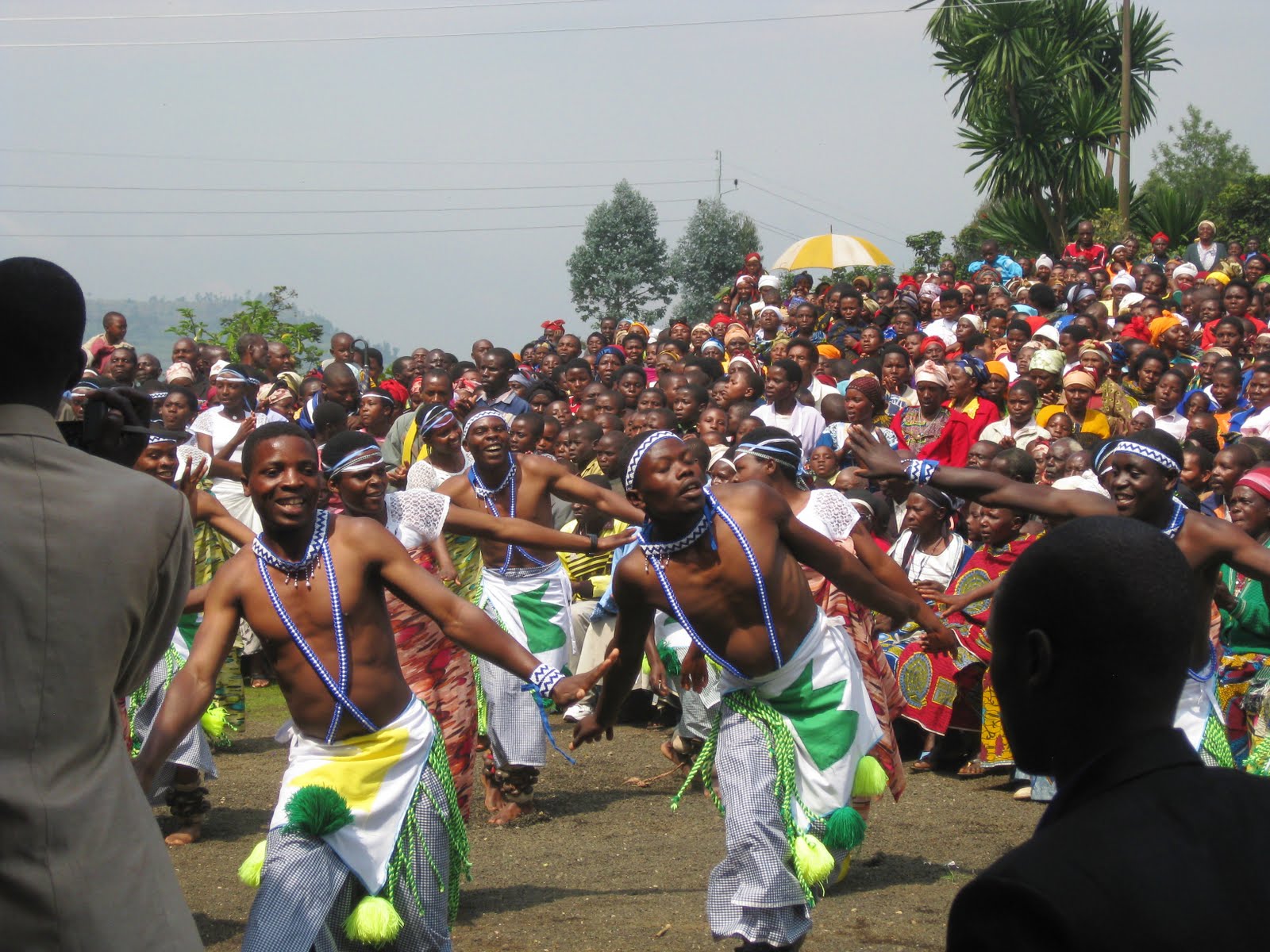
He was so ecstatic that I came and introduced myself to him in Kinyarwanda on my first day here that he made a point of introducing me to the church congregation of thousands on New Years by asking me to make a speech. The service itself was actually so much fun that it wasn't even nerve-wracking to have to introduce myself. It was so large that it had to be held outside because not everyone could fit in the church. There was a sermon-making in Kinyarwanda (some of which I could actually follow, but spent a fair portion of playing with children) followed by several other components than I am assuming come pretty standard at Mass anywhere.....waving around frankincense and praying etc. Father Vincent and the sisters then proceeded to give the sacrament to the entire crowd as they lined up in an impressive and tedious feet of crowd management. But then came the dancing. It was headed off by the same sleepy girls that normally perform at rather solemn Sunday Mass, but it really started to pick up from there with dancers in brilliant costumes jumping all over the place and, eventually, get the crowd to join them. Sister Rukundo, who I am coming to love, got up a shook it with the rest of them.

However, not every day in paradise is so perfect. There are days that I am too tired to play with the kids outside of my house and wish they would stop calling my name. There are also days that I wish they understood dogs the same way Americans do so the kids wouldn't incite Beans to play with them and then run away screaming bloody-murder when she actually does. Granted, her training is going fairly well and I can stop her before she gets too riled up most of the time now. And then there's Alphonse, the town umusazi (crazy man). It's hard to say what's happened in his past, but he's clearly of an age that he would have witnessed the crimes of 1994 and there are no psychological services to speak of in Rwanda to help people to deal with trauma. As a result, he stumbles around each day, rambling into a telephone that may or may not even have someone else on the other end, yelling at people. I'm pretty sure that he's harmless, but that the village people are afraid of him because he's different and being treated differently is something I can emphasize with quite well. I want to reach out to him, but it doesn't help that he's obviously a bit scared of me because of my skin. I actually think he would really appreciate it if I would leave so things could go back to normal, as evident by the fact that he normally follows me around the marketplace trying to scare me when he sees me there. Thankfully, my village people are very protective of me so I rarely need to tolerate this for very long.


For the most part, my village has been extremely welcoming and easy to move in to. I'm excited now that classes have officially started (which I will have to write about later) and I have a distinct purpose, but I am also looking forward to working on my own projects in the village. The priests and nuns want to learn English in exchange for French and my farming friends want to learn yoga after I told them I was more worried about their backs than my own. So much to do and so little time. Two years is already starting to feel like nothing at all.

Sunday, December 18, 2011

Starting Over Again

So....it's been a long time since I've had time to blog and I still don't really have time, but I figured I would do it anyways, given a rare opportunity to use the internet since a priest in my village has loaned me a modem to connect.


Last week marked the end of training and the beginning of my life as a Peace Corps Volunteer (PCV), which means that I have had a lot of goodbyes to say in the past week. Before I even moved out, Fanny had already left to visit a friend in Uganda. I think she thought my plans were to leave on Monday since she was shocked to hear that she was leaving before me so it felt a bit strange to say goodbye with the roles reversed. I'm also terrible at goodbyes (having pretty much used up all of my capacity to be good at them three months ago when I left Colorado) so we mostly just woke up at 6:00 to look at each other awkwardly for a while only to agree that we would see each other again soon.


We were picked up early on Wednesday morning and, in a giant mess of moving 36 trainees from various homes (with various disastrous road conditions) and loading all of their worldly possessions into one giant moving truck right before a rain storm, we were off to Kigali. I had two days in the city before I was to be dropped off at my site, which meant that I power-walked all over the city to insure I could open my bank account, buy groceries and appliances, and order Chinese food (all of which is a lot more hectic when you don't own a car and you're in a foreign country). On Thursday, we were officially sworn in as volunteers at the US Ambassador's house. It was somewhat surreal, sitting there under a the shade of a canopy on a perfectly trimmed lawn, listening to a few of the volunteers make speeches in English, French, and Kinyarwanda that were being broadcast on national TV and radio...and then following the event with an American-style buffet. It felt nothing like the past couple of months and probably nothing like the next couple of years either.

On Friday, we started moving out at 7:00 am and, after a lot of crying and hugging and saying goodbye to other volunteers (some of which had to wait a couple of days before they would be taken to their sites) and dropping off another volunteer, I was officially home. Minutes before we arrived, the driver and I realized that we had no idea where there was a key to my house. I would have been panicked, but these things have a way of working themselves out when you're in Peace Corps and, sure enough, right when I pulled up to my house, out came Faustin, the boy I had been paying to look over my dog before I moved in. I could not have possibly hoped for a better welcome. I should preface this by restating that Rwandans are not known for their love of dogs. In fact, they are known for fearing and loathing them. But there was Faustin, coming out of my house to inform me that he had just been cooking beans and potatoes for Jellybean and asking for permission to stay awhile so he could finish making her lunch. I don't even take the time to cook for my dog in the states.

Faustin isn't the only Rwandan around here that seems to be counter-culturally infatuated with dogs. Not everyone loves Jellybean as much as he does, but they do seem to accept her as entertaining and harmless, making integrating into the community a lot easier than I thought it would be. It also gives me excuses to take frequent walks in the fields surrounding the village and, let me tell you, this place is beautiful. The soil is incredibly fertile since we are located right next to Volcano National Park and everywhere you look is covered in rich, green, rolling hills.


I'm also conveniently located right next to the church, which my neighbor Father Vincent tells me hosts up to 40,000 people (I'm not sure if that number got lost in translation or not, but the point is is that it's a LOT). This means that if I venture out into my back yard on Sunday morning, I can basically meet the entire surrounding area in the span of half an hour (which is exactly what I did yesterday). It also means that, whenever there is a wedding, I can feel free to invite myself, as per Rwandan culture, which has absolutely no problem with wedding crashers. Living in such close proximity to the church has other perks as well. For example, I have a constant soundtrack of African influenced hymnal music going if I ever need something to listen to, which sounds AWESOME. I also have a built in clock in the form of a giant bell outside of my house that will tell me when it is 6:00, 15:00, or 18:00 in case my clock ever breaks. The other perk is that my neighbors are decently wealthy, education, and excited to work with me. I made a point to go and visit the parish and the convent soon after my arrival and I was gifted with bread, milk tea, pineapple, fanta, and even the modem I am using to type this up right now when I mentioned that I didn't have a way to get in touch with my family. The generosity of the people around me is astounding.


One of my other favorite things about being here is my proximity to Congo, which has always been a serious interest of mine. There is a refugee camp about 15 minutes down the main road from the turn off to my village and I can feel a distinct difference in the culture here. Yesterday, I stumbled upon a group of teenagers dancing in the rain, which poses two contradictions to traditional Rwandan culture since Rwandans don't seem to like to dance nearly as much as Congolese and because they would never be caught dead in rain like the one we had yesterday. Sister Rukundo, one of the nuns I have befriended is also Congolese and spends a good deal of her time going back and forth between Rwanda and Goma, which is where she is fun. She reminds me a lot of Mupemba, our Congolese training director, who completely un-Rwandan in how load and confident and candid he was. She's also a veterinarian, which is a very odd thing to find here, which seems to have very little animal culture.


Of course, there's much more to being a PCV than sitting around and enjoying the benefits. I have a lot to do to lay the groundwork for the next couple of years. Some of it is just maintenance like training Jellybean to go to the bathroom outside as opposed to in the bathroom (which she seems to think is acceptable because she knows I do it) and to get some of the holes in my roof repaired. Most of it, however, is just about being a human being and making friends. Already, the people in my village seem to be super impressed that I can actually speak any Kinyarwanda at all, but I don't want to leave it at that. I'm making a point to get out in the village and start getting to know people beyond simply saying good morning to them. Today that will mean a lot of walking and greeting, but the people of my community have been so receptive and welcoming that I'm honestly looking forward to a three hour walk-and-talk all in Kinyarwanda. Faustin has also offered to help continue tutoring me in Kinyarwanda, but something tells me that I will have plenty of teachers and I've also realized that I actually know enough to hold a casual, if not more philosophical, conversation (thank you community-based training!).


Well, I guess I'm off!

Wednesday, November 30, 2011

Love Don't Cost a Thing....Or Does It?

Last weekend was a learning experience in two of the most important aspects of Rwandan culture: money and sex. Not to say that these are disproportionately important in Rwanda, but that they are important everywhere, but different in Rwanda from anywhere else I've ever really been.

Saturday marked our third and final Umuganda (community work day) during training. Last month, most of our families opted out of Umuganda, which meant that most of us spent the morning at home, doing laundry with the door locked for fear that we might be found out. My family was ditching as usual this month, but this time it was because of the legitimate reason that the wall to our compound had mysteriously caved in and they needed to take the time to fix it. Since I wasn't needed at home, I decided to go to Umuganda without them. However, this time was nothing like our first experience when which we built two full roads in the course of a morning. We arrived at the Umuganda site, meant to be the construction of a new district office, to find about 20 men sitting on a mound of dirt watching two others shoveling dirt to mix cement. We stood around being gawked at for a while before we decided to use one of the hoes we had brought with us to teach our audience to limbo while they waited. About an hour in, there still wasn't much to do and it was becoming clear that that wasn't likely to change and, at this point, some of us went home to do laundry. The most productive part of the day came when we loosened some of the soil near the construction site to plant crops, but this was a pretty short lived activity and I was beginning to understand why my family normally seems to opt out of going.

Umuganda is a great idea in theory, but, like many theories, isn't so hot in practice. On some days, like the day of our first Umuganda, having a large labor force put to work for a morning can be a huge driving force in development. However, it is almost impossible to expect that kind of outcome every time because the projects the community has real need for are constantly changing and not always the kind of projects that can easily be accomplished by large groups of unskilled workers. The construction project we were supposed to participate in this weekend is an excellent example of that. It also seems that Umuganda is more for the poor than for the rich. If you are wealthy, you can afford to pay the fine for refusing to attend (not that it's often enforced) and maintain your status in a society that frowns upon getting one's hands dirty. Also, if you are wealthy, there is a good chance you live in Kigali, which has far less need for Umugandas and which is also where I ended up on Sunday.

Kigali is a world already entirely different from rural Rwanda: the roads are mostly paved; electricity is a standard rather than a luxury; and there are foreigners everywhere, which means that people are acclimated enough to Americans that they don't stop what they are doing to watch them like they normally do in the country and like they did on Umuganda. Honestly, I feel like this contrast causes me a little bit of culture shock. A friend of mine pointed out that the vast economic disparity is probably one of the best indications of Rwanda's development. Granted, it is hard to see the inequity just between the nation's capital and the majority of it's citizens outside of major cities (so dramatic that you can find urban Rwandans eating burgers and milkshakes in the city, but only the wealthiest can regularly eat rice in the countryside), but in a few years, the wealth could start to spread.

We came into Kigali with two purposes: to stock up on Western food and to attend a wedding for Kassim, one of Peace Corps' teacher trainers for ESL and the man I will report to when I move to my site.

The wedding was beautiful; it would be hard to find a more brightly colored gathering. Women came dressed in their brightest garments with beautiful wraps for their hair. The men wore Western tuxedos that sparkled in the sunlight, but the color scheme of the wedding were decked out in it. They wore shiny yellow, gold, and bright green with golden head bands that I could have never pulled off in my life, but they definitely knew how to work. As always, the bride was the most decked out of anyone in all of the same colors as her bridesmaids, but with much more fabric and a gorgeous gold-embroidered green hi-jab. The guests were seated (men on one side and women on the other) under giant white canopy tops that provided plenty of shade, but started to overheat from the hot air rising off of all of the guests below them. Everything was decked out in the bride's colors, creating so much of a spectacle that a Western couple in a nearby guest house stopped what they were doing to watch the ceremony from their balcony (I wondered if they were aware of how much of a spectacle they were themselves by wearing shorts and a strapless dress, clothing that is certainly not appropriate by Rwandan standards and especially by Rwandan Muslims). Even the juice that the bride and groom pored for each others' family members in a gesture of coming together was dyed florescent green and yellow to match the theme.

We weren't able to attend the actual wedding at the mosque, but the dowry ceremony which takes place before the wedding when the family of the groom traditionally presents the family of the bride with a cow is a crucial step in getting married in Rwanda. Kassim's family is relatively well-off and urban so they didn't actually present the bride's wife with a cow (as they would in the country side), but they did present them with a large enough sum of money to buy a cow if they wanted and several other gifts as a symbolic gesture. The gift that struck me the most was a bottle of Coca-Cola, which was pretty telling of how rapidly Rwanda is developing, but also of the way that corporate American junk food is taking over the world. After the prayers had been made, the gifts exchanged, the juice pored, every member of each family had been greeted by the couple, and some photos had been taken, it was time to eat. We were served fanta by women in giant, billowy, Aphrodite-like dresses and then helped ourselves to a giant buffet full of food with infinitely more spice than we are accustomed to getting at home (which is none).

It dawned on me how much emphasis the dowry ceremony, as an expected precursor to the wedding, places on the transactional nature of marriage in this country. Certainly, judging by Kassim's smile last Sunday, this particular marriage was more about love than it was about money, but the conversation I had with my host sister later that night about the monetary aspect of Rwandan marriages told me that Rwandans still place a lot of import on the ability of the husband's family to provide which is indicated in paying for the wedding and in presenting the gifts at the dowry ceremony. To a certain extent, the transactional nature of marriage is present everywhere (and it certainly used to be much more prominent in the states), however, the concept is still a bit foreign to me as an American, having grown up hearing people swap vows to love each other “for better or for worse” and “for richer or for poorer” values that naturally extended to the engagement and the wedding ceremony as well.

Of course, the Rwandan notion of romance is pretty different from what I'm used to in general. In an HIV conference we had today, students were asked to relay their expectations in romantic relationships. Before they ever listed love or trust, they listed family, which is the primary expectation of love and marriage. This also provides a lot of explanation for the heavy emphasis on the financial security necessary for supporting a Rwandan-sized family (sometimes with up to 15 children) and why sex and money are thought to be so much one in the same (so much the same that there is a noticeable spike in the HIV positive percentage of males in Rwanda around the age of 44-45, when they most commonly become financially independent and wealthy enough to pay for prostitution). This is changing rapidly. The Kagame administration has placed heavy emphasis, not only on development, but also on health and family planning, which means that family size is on the decline, hopefully creating more time for married couples to enjoy a bit of romance in their lives.